
A single implant with a crown runs $3,000 to $7,000 in most Canadian cities. A full arch, meaning every tooth in the upper or lower jaw on four to six implants, is a different story. The quotes I see in Alberta run from about $20,000 to $40,000 per arch. I've seen the same mouth quoted at both ends. The difference was almost never the surgeon's skill. It was what the quote left out.
So I'm going to do this backwards. Instead of a price, I'll tell you what you're paying for, where the gaps hide, and then what we charge and why it's one number. If you only want our fees, they are on the pricing page. Everyone else, stay with me.
What the money actually buys
An implant is a titanium post set into the jaw. The fee is for everything around it: the 3D scan, the surgery, the surgeon's time, the temporary teeth you leave with, the final bridge or crown, the lab that makes it, and the follow-ups while the bone heals around the posts. For a single tooth that's one post, one crown, three or four visits. For a full arch it's four to six posts placed in one morning, a temporary bridge made while you rest, and a final bridge three to six months later.
The biggest swing in a full-arch price is the final bridge. Zirconia, which is a solid ceramic, costs more than an acrylic bridge on a titanium bar, and it should, because it wears far slower and doesn't stain or chip the way acrylic does over the years. We recommend zirconia and we offer both. The honest comparison is on our zirconia versus acrylic page. The second swing is the lab. A clinic that sends your bridge out to a commercial lab pays that lab, and you pay the clinic. Ours is made in the building, by people I can walk over and talk to, which is part of why I can quote a flat number.
Why two quotes for the same mouth can be thousands apart
A low full-arch quote is often a quote for the surgery only. Read the fine print and the temporary teeth are extra, the final bridge is extra, the extractions are extra, and the follow-up visits are billed one at a time. By the time you have your finished teeth the low number has caught up with the high one, and sometimes passed it.
Then there's the bone. If you've worn a denture for years, you have less jaw than you used to. Most of that loss happens in the first year or two, which is why I tell denture wearers to come sooner rather than later. Less bone can mean a bone graft at $800 to $3,000, or a sinus lift at $2,000 to $4,000, and months of waiting before the implants can go in. We avoid a lot of that by tilting the back implants and, on the upper jaw, using the pterygoid bone at the very back of the upper jaw whenever it's there. That doesn't remove the need for grafting in every case, but it removes it in many, and that shows up in the price.
What we charge, and what's in the number
At Smile Now a single implant with its crown is $3,500. A full arch of fixed teeth, is $25,000 in zirconia (All-on-4 or All-on-6) or $20,000 for All-on-4 with an acrylic bridge, per jaw. Both jaws are $47,000 in zirconia or $40,000 in acrylic. That covers the consultation and 3D imaging, the extractions, the surgery, the implants, the temporary teeth the same day, the final bridge from our own lab, and the follow-up visits through healing. The warranty is published on its own page so you can read it before you commit.
What isn't in it: IV sedation, which is optional and quoted separately based on how long your procedure runs; any grafting that turns out to be needed; and zygomatic implants, the long ones anchored in the cheekbone for people with very little upper jaw left. All three are quoted at the consultation after the scan. Pterygoid implants, which I use whenever the bone is there, are part of the $25,000 zirconia tier. Those are the only three things that change the number.
Is that expensive? Yes. I'm not going to dress it up. It's also a long-term fix for people who have run out of patience with dentistry, and the ones who go through with it tell me it changed more than their teeth. When patients ask me what holds people back, it's money, by a wide margin, far ahead of fear of the surgery. My only answer is that you have to decide you are worth it.
Who helps pay
The Canadian Dental Care Plan does not. It excludes every implant-related procedure, though it does cover extractions and a conventional denture, which matters if you need to get out of pain first. I wrote that up in detail in the CDCP post. Private insurance usually pays a share of the surgical part of an implant and nothing toward the bridge, with a yearly cap that is a small fraction of a full-arch fee. We send a pre-determination from the consultation so you know your insurer's number before you decide.
For the rest, we have in-house financing and Beautifi, our third-party financing partner, both subject to approval, with terms confirmed at your consultation. And if a fixed bridge is out of reach right now, a snap-on denture on two to four implants is a real step up from a regular denture at a lower cost. We'd rather get you something that works than nothing at all.
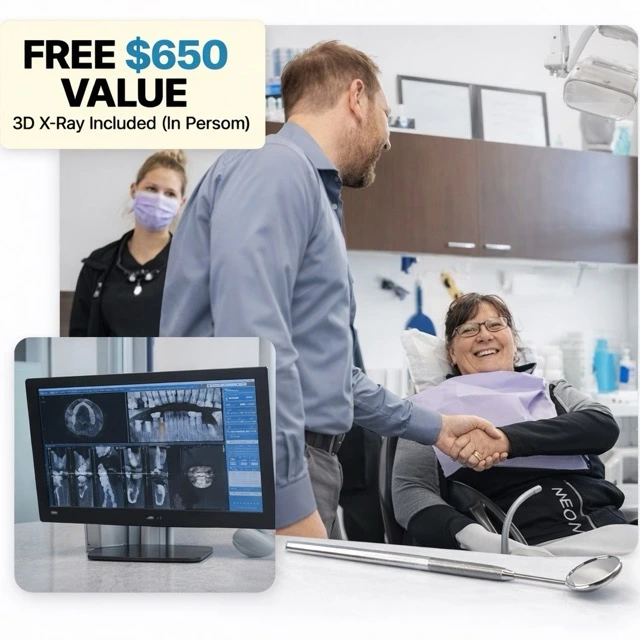
If you want a number for your own mouth rather than a range off the internet, the consultation and the scan are free. Book one, and you'll leave with the actual figure.